
Early Pregnancy Scans & Reassurance | Your Baby Scan
Early pregnancy can be fine a minefield of emotion, worry and excitement. For most people it’s normally their first introduction to ultrasound as a method of medical imaging. Below, you’ll find some information about how your baby is developing at this stage of pregnancy, as well as a range of scans that can let you see your baby developing, put your mind at ease and confirm that everything is progressing well.
It’s common for newly pregnant mum’s to not know how far they are, to even try to plan for which scan they would need as unless you’re using a more expensive digital pregnancy test that tells you in weeks how far you are, you’ll only know that you’re pregnant. Not to worry, we’ve created a handy little calculator to help you work out how far you are.
Gestational Age Calculator
Your Results
Note: This calculator provides an estimate based on your last menstrual period. For the most accurate dating, please consult with our sonographers.
Early fetal development

4 weeks
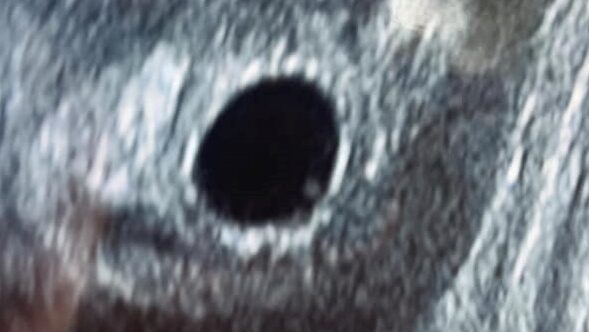
At 4 weeks, it’s normal for the gestational sac to not yet be visible, even with an internal scan. At this stage, we are looking for a thickened endometrial lining (the lining of your womb) and no signs of free fluid that may suggest that implantation has taken place outside of the womb.

5 weeks
At 5 weeks we get the first glimpse of the gestational sac and mostly this is only with an internal scan. During this week we may see the initial development of the yolk sac which will later develop as part of the placenta.

6 weeks
At 6 weeks the yolk sac should now be clearly visible, and during week 6 we should be able to see the fetal pole, this is the first stages of the embryo becoming visible.

7 weeks
At 7 weeks this is often the most reassuring point in the early stages of pregnancy as that little flicker of a heartbeat can be seen on ultrasound. We won’t listen to it yet, and it’s not visible enough for us to see the chambers of the their tiny heart, but you’ll definitely see it flickering away.
Ultrasound Scans for Early Pregnancy
For 5-12 weeks pregnant
Pregnancy Viability Scan
From 5-8 weeks
A scan to confirm the location of the gestational sac, and embryo development. Scan will start as an abdominal scan, but includes an internal (transvaginal) scan if needed. Typical confirmation scans are less than 7 weeks and therefore the heartbeat cannot normally be visualised reliably at this stage of pregnancy; if you are more than 7 weeks during this scan you’ll be able to see your baby’s heartbeat on screen too.
What’s Included:
- 1 x Goodie Bag
- 1 x Internal Scan
- 1 x Large print (6"x8")
- 1 x Online Photo Locker
- 1 x Scan Report
(£70.00 when booked online)

Early Reassurance Scan
From 7 weeks+
Short 2D scan (Black & White) to confirm pregnancy and check the health of developing embryo and fetus at this early stage in pregnancy. This scan offers an opportunity to view your developing baby before you’ve had your NHS Hospital appointment
What’s Included:
- 1 x Scan Report
- 1 x Small print (4" x 6")
(£60.00 when booked online)
Early Gender Bloods
From 6 weeks+
Did you know that as you share your blood with your baby, they are sharing their blood with you too.
That means your blood contains fetal DNA and from 6 weeks+ this is developed enough to read your baby’s chromosomes and determine their sex with 99.9% accuracy.
We highly recommend an ultrasound scan to confirm you are at least 6 weeks pregnant before taking the blood test for peace of mind as LMP cannot be relied upon. This can be an appointment you’ve had with the NHS or another private clinic, and doesn’t have to be with Your Baby Scan.
Pricing from:
£109Please note: Whilst our scans are performed by fully qualified HCPC registered sonographers, if you are experiencing any bleeding, or symptoms of ectopic pregnancy we would always recommend contacting your nearest BEP Clinic, Hospital EPAU or, in the case of symptoms of ectopic pregnancy, your nearest A&E, where you are in reach of medical assistance if it is needed urgently. We understand that from time to time, often at weekends, your local BEP clinic or EPAU may not be able to see you which can cause potentially unnecessary worry in which case we are able to scan you to provide you with reassurance of baby’s well-being at that point in time. Your nearest A&E is available 24 hours a day, 7 days a week and should always be your first point of contact for ectopic pregnancy symptoms.
Blood testing services
Did you know that Your Baby Scan also offer blood testing services using fully qualified and experienced Phlebotomists too?
We offer a range of blood testing services through our lab partners which can be useful for these early stages of pregnancy.


Beta hCG Blood Test
Beta hCG is part of the hormone produced by the placenta shortly after a fertilised egg attaches to the uterine lining.
A Beta hCG blood test can be used to determine your hormone levels and can be used to determine how many days pregnant you are. This is often useful if you are undergoing IVF treatment, or have been getting misleading readings from a home pregnancy test.
Two separate tests 24-48 hours apart can confirm that pregnancy is progressing.

NIPT Blood Tests
Non-invasive Prenatal Testing (most commonly known as the Harmony test) is the screening of cell-free DNA from the fetus (cfDNA) in mum’s blood to identify the risk of a wide range of genetic conditions.
Certain factors such as age or family history can increase the likelihood of these genetic conditions.
NIPT does not provide a diagnosis can help to identify the need for further more invasive testing such as amniocentesis without putting your baby at any risk as the sample is taken from mum’s blood intravenously.

Gender Blood Tests
Using similar methods to NIPT testing, gender determination blood tests can be used to examine cell-free DNA from the fetus (cfDNA) in the mother’s bloodstream to determine the fetus’ chromosomes and therefore sex.
Gender blood tests can be carried out from as early 6 weeks into pregnancy with 99.9% clinical accuracy. The closer to 6 weeks that you are some labs will require confirmation from ultrasound to confirm gestational age is 6 weeks+ in order to guarantee the accuracy.
Unlike home testing, samples are taken intravenously to rule out contamination.
Which scan is best for me?
At Your Baby Scan, we completely understand that different people have different needs, worries and concerns. Choosing which early reassurance scan is right for you is just as unique. We’ve put together a guide to help you when choosing. See if you can relate to any of these statements:
“I’m worried that my baby is developing in the right location”
or
“I’d just like confirmation that I am actually pregnant, I’ve done multiple pregnancy tests, and I just can’t believe it”
Then we’d recommend our Pregnancy Confirmation Scan. This scan is the earliest stage of pregnancy, from just 5 weeks, that the gestational sac becomes visible and we can check their position.
Caution:
Don’t choose this scan if you think that not seeing anything would worry you even more. It’s incredibly common for people to be less weeks than they are based on their LMP date. This is because conception can take place later, but if you are little less than expected, this would make you less than 5 weeks which means we may not be able to see anything.
“I just want to see that heartbeat”
or
“I want to be able to see my baby”
Then we’d recommend out Early Reassurance Scan. This scan is available from 7 weeks onwards.
Caution:
We’d recommend coming around 8 weeks if not seeing a heartbeat would worry you more. It’s common to be a little less than you expect to be based on your LMP date, as conception can take place later. Coming around 8 weeks reduces the risk that you’re too early to see your baby’s heartbeat on the screen.
What happens during an early reassurance scan?
At Your Baby Scan, we only believe in hiring Fully Qualified, HCPC Registered, and experienced sonographers. During your scan, your sonographer will check around your ovaries, the adnexa (the area where your fallopean tubes are) and around your womb before taking a look at the contents of your womb for your baby.
When looking for your baby, we’ll be looking initially for the gestational sac; this is the first thing we see in pregnancy. Then we’ll be taking a look for your yolk sac; this will develop later in pregnancy to form part of your placenta, which will provide nourishment to your baby throughout pregnancy. Finally we’ll be looking for the fetal pole and hopefully an embryo. The fetal pole is a thickened area next to the yolk sac, and is the earliest stages of the developing embryo, this will develop into a fetus. If you are measuring more than 7 weeks, we would expect to see a fetal heartbeat on the screen too, though at this stage of pregnancy it’s only a tiny flicker. This will become more clearly visible over the next few weeks.
Whilst the sonographer is checking around your ovaries, adnexa and womb, she’ll be checking for any free fluid (which can be perfectly normal, but can also be a sign of something more sinister), and she’ll be checking for any signs of bleeding.
All of our scan start abdominally so you’ll need a full bladder for your appointment. Whilst an internal (transvaginal) scan will always allow us to see more easily, and we take every precaution that we can, there is always a small risk of bacterial infection from an internal scan. We’d rather avoid that risk completely if we can. However, if your sonographer is having difficulty seeing everything that she needs to she may assess the benefit of an internal scan to outweigh the risk. This is common with our Pregnancy Viability Scan, at around 5-6 weeks, and is included in the price as a result. It’s not normally needed for our Early Reassurance Scan if you’re 7 weeks or more, and therefore if one is needed with your Early Reassurance Scan, there is an extra charge for this.
In both of our scans, we completely understand that an internal scan is an intimate procedure, and therefore if you wouldn’t feel comfortable having a transvaginal scan, please just say no. Our team won’t be offended, and will rebook your scan for the right number of weeks based on what they have been able to see abdominal at no extra charge so that they can complete your scan.
If your Sonographer see’s anything of concern during your Pregnancy Viability Scan or Early Reassurance Scan, they will make a referral to the right NHS clinical care team for further diagnosis and care. This is why we only use Fully Qualified Sonographers, and not Ultrasound Technicians, or Midwife Sonographers.
Regardless of the outcome of your scan, we will provide you with a fully comprehensive report of our findings which we recommend included in your NHS pregnancy notes as this helps your midwife and NHS Sonographer to baseline your baby’s development in any future scans you have with them.
These guys are amazing and what an absolute bargain!
Frequently asked questions
Questions about Early Reassurance Scans
-
Do I need a full bladder for my scan?
For all scans up to 21 weeks we require a full bladder prior to scanning. Filling your bladder helps to lift baby out of the pelvis and make it easier (and therefore clearer) to see which is essential for checking baby’s wellbeing.
Anything you drink can take around 20-30 minutes to get to your bladder so we recommend drinking around 2-3 pints of water 20-30 before your appointment time so that it has time to fill up. Anything you drink after you arrive for your appointment is likely to be filling your bladder after your scan has been completed which could make for an uncomfortable journey home.
-
I have bleeding or pain, can I have an appointment?
If you are experiencing bleeding or pain it is essential that you contact your NHS clinical care team in the first instance. They will most likely want to provide you with a scan, and will have clinicians and facilities available if you need urgent treatment which will not be available in our clinic
About us
-
Where are you based?
Your Baby Scan currently operate 2 private scan clinics in Widnes and Crewe. Each scan centre is open 5 days a week, with both open on a Saturday. The days that we are closed at each clinic differ, allowing us to offer 7 days a week availability between each scan centre.
-
Are you registered with the CQC?
Yes! Absolutely!
At Your Baby Scan, we are providing non-diagnostic ultrasound to see your baby. The use of ultrasound is a Regulated Activity in England, which the Care Quality Commission (CQC) are the Regulator. As a result, there is a legal requirement for any provider offering ultrasound, regardless of whether they are qualified, competent, or delivering that service safely to be registered with the CQC.
You can view full details of the registration for Your Baby Scan here, along with the rating of our service for each of our clinics:
-
Are your sonographers fully qualified?
Yes, absolutely. This is something that we feel is both very important, and sets us apart from some other clinics. We use only fully qualified HCPC registered sonographers. This is someone that has not only had the training at university in Radiology and specialism in Ultrasound, but has received training on multiple areas of anatomy.
All of our sonographers have experience in all aspects of both obstetric and gynaecology ultrasound, and have many years experience working in a diagnostic setting in hospitals.
We do not employ Midwife Sonographers, who do no hold HCPC registration, but instead are registered with NMC (Nursing and Midwifery Council). In our experience most midwives, whilst having full knowledge of pregnancy, have only received a limited amount of training in ultrasound in specific types of scans. For example, a midwife may be trained in early pregnancy scanning, but not trained in anomaly scanning, or presentation scans, or visa-versa.
For your safety, we make a conscious decision to only employ fully qualified, experienced HCPC sonographers, so that they have the skills and training to be able to cover all areas of ultrasound, throughout your pregnancy, and ensure that you receive the right care if we identify something that needs it.
-
I haven’t felt any movements for a number of hours…
Whilst we understand that not feeling your baby’s movements can be very worrying, there is no set rule to when, and often a baby should move. Each pregnancy can be different, and you will get to know your baby’s movements.
If you are worried about your baby’s movements, in the first instance you should contact your hospital’s maternity unit straight away. The clinical care team at the hospital will not only be able to monitor you and your baby safely over a period of time, but they will also be able to provide you and your baby with the right support if there is anything wrong.
Further information about babies movements can be found here:
https://www.kickscount.org.uk/Pages/Category/why-movement-mattersOnly if your NHS Clinical care team cannot or will not see you, will be able to offer an appointment to provide reassurance. Any appointment will only be able to check for a current fetal heart beat to ease any anxiety and should not be a substitute for being checked over by your clinical care team.
-
Do I have to pay in full?
All of our appointments require a non-refundable deposit of just £10 to secure your date/time. We have this as the lowest possible so that it only covers costs that we have incurred to service your appointment from the point of booking. At this time, appointments can only be booked with the minimum deposit either via our online chat (where a secure link can be provided for payment), via telephone (0330 223 1169) or in person at any of our clinics.
-
Can I cancel/change my appointment after I’ve booked?
Yes of course!
We don’t charge anything to rearrange your appointment to another date or time. We recommend looking through the real-time availability on our website to choose your new time first, and then contacting us via either our online chat or social media channels, or calling us to rearrange.
If you do need to cancel your appointment at 24 hours notice must be given to be eligible for a refund.
Our non-refundable deposit is as low possible so that it only covers costs that we have incurred to service your appointment up to that point in time. Anything that you have already paid above and beyond the £10 deposit will be refunded at your request.
Full details of our refund policy can be found here: https://www.yourbabyscan.com/refund-policy/ -
Do you have parking?
Yes, both of our scan centres have dedicated parking. For details specific to each clinic, go to the respective clinic’s page from our Contact Us section.
-
Can I get to you via train or bus?
Yes you can. Both of our scan centres are located on bus routes, and main-line train lines with train stations within walking distance. You can find details for each clinic via our Contact Us page.
What will my scan be like?
-
Who can I bring to my scan?
Here at Your Baby Scan we want your experience to be the complete opposite to your NHS scan. We know that they only allow 2 people to your scans. We want you to be able to share your experience with your mum, dad, nan, gran, aunt and uncle and even your neighbour!
Typically we allow yourself plus either:
- 3 adult guests plus any dependent children
- 5 adult guests
We have a large TV screen in Widnes, and an even bigger projection screen on the wall in Crewe, so everyone can see.
-
What if the sonographer sees something wrong?
Whilst we don’t go out of the way looking for problems, if our sonographer does notice something unusual then with your permission we will refer you to your midwife or local hospital and our sonographer will provide you will a clinical report of our findings and letter to take with you.
Each of our sonographers are fully qualified in performing diagnostic obstetric ultrasound scans, so they are more than capable of measuring for example the amount of fluid around baby, or nuchal translucency inline with NHS and UK protocols, but they will not perform these measurements unless they happen to have a cause for concern.
Our sonographers will absolutely not hide away from telling you if there is something wrong.
-
What if I don’t want to know the Gender?
This is fine, we completely understand that some people want to keep the sex of their baby a surprise. When you complete your digital consent, you will be asked whether you already know your baby’s sex, and if you don’t, whether you would like to find this out during your scan. During your scan, we will avoid the genitals throughout the scan. If there are any times when the sonographer may been to pass near the area (such as when carrying out wellbeing checks) the sonographer will blank your view of the screen off temporarily until it’s safe for you to view the screen without spoiling the surprise for you.
-
Do you charge more for twins, triplets or quads?
No, although we would suggest a 30 minute appointment to ensure you get plenty of time to see all of your babies, you are more than welcome to come to one of our shorter appointments and you will not be charged any extra. This simply allows less time to see each of your babies.
-
Can I have a chaperone?
Yes, chaperone’s are available for all of our scans.
We request notification in advance of your appointment where possible to ensure that this can be accommodated. Without notice, if a chaperone is not available, we may unfortunately have to rearrange your appointment to accommodate your request.
-
Do I have to wear face masks at the clinic?
This is perhaps the most contentious question that we are asked each day, particularly since the government announcement that all COVID restrictions were removed in England.
Facemasks are not required in our clinics for adults and children over 11 years of age but are recommended for yours, our staff, and other patient’s safety in our clinics. In addition, pregnant women, who have reduced lung capacity due to pregnancy, are considered high-risk, and vulnerable should they contract COVID-19 during the later stages of pregnancy which could further reduce lung capacity. The effects of COVID on the developing fetus are as yet unknown, but the RCoG do not believe that the risk to the fetus development is high.
The latest version of the National Infection Prevention and Control (NIPC) Manual is available online.
We will endeavour to follow national guidelines at all times, and rules may change from time to time. It is important for us to stress that these rules are applied to us, not rules that we have created because of any personal beliefs. We understand that some people do not believe in wearing face masks and feel that this infringes on their human rights; by following the rules and guidelines that are applied to us, we are sorry if this causes any offence. It is absolutely not intended.
-
How long will my scan be?
This is a complex question to answer.
Our appointments are typically in 2 different lengths according to what is involved in each scan and how long they normally would take. You can see the appointment duration against each package on our website.
If your appointment is 15 minutes, we typically expect around 5-8 minutes of scan time.
If your appointment is 30 minutes, we typically expect round 15-20 minutes of scan time.
However, we follow ALARA (As Low As Reasonably Achievable) so scan time should be kept to the minimum it needs to be to achieve what the scan is intended to be for. We also don’t limit the amount of time that our sonographers scan you for, so if your baby is in a difficult position, or the sonographer needs to look at something in more detail, we won’t stop the scan at the above times.
When planning for your visit, regardless of the length of your appointment, we always recommend allowing time to be in the clinic for an hour, this allows you to take time to go for a walk if needed to get baby into a better position rather than giving up.
If for any reason we can’t get the views that are needed to complete your scan as it is intended we will always offer a rescan at no charge.
You can find more information on this topic here: Whats the difference?
-
What happens if I’m late for my appointment?
If we can we will try and fit you in to accommodate you, however we may have to re arrange for another day. We do ask that you try and let us know if you are going to be late or cant make your appointment. You may lose your deposit if you don’t let us know.
If you can let us know that you’re on your way, but are likely to be late (e.g. stuck in traffic) then we may be able to let the next appointment go in for their scan early, and you can take their appointment slot. In any case, we’ll do our very best to see you as soon as it is safe to do so.
-
What if I feel unwell after my appointment?
Get help from NHS 111 if:
- you’re worried about your symptoms
- you’re not sure what to do
Alterntatively you should contact your midwife, GP or clinic care team in the first instance, the same as you would if you hadn’t attended an appointment at one of our clinics. This is to ensure that you receive the full and correct treatment for your symptoms.
If you are diagnosed with a virus (including, but not limited to, m-pox and COVID), please contact us to let us know of your infection so that we can take the necessary precautions to protect other patients.
What technology do you use?
-
Is an ultrasound scan safe?
There is currently no evidence to suggest that ultrasound (including 4D Bonding Scans) are harmful, however, it is important that you have all of the facts about the risks associated with the procedure before coming to your decision on the matter. In general, it’s recommended for good measure to keep your scan times to a minimum, and that this is particularly during the early stages of pregnancy, for this reason, we will end scans during the very early stages of pregnancy once we have been able to provide you with the reassurance that you seek.
The following links will help:
- Public Health England guidance
- NHS Fetal Anomaly Screening Programme
- Care Quality Commission (CQC) – Choosing a baby scanning service
- British Medical Ultrasound Society (BMUS)
- EFSUMB – European Federation of Societies for Ultrasound in Medicine and Biology
Whether you choose to have a scan with us or not, it is essential that you keep your NHS Ultrasound appointments.
-
Does ultrasound use radiation?
It is a very common misconception that because our 2D images show a cross-sectional image in black and white, which can similar to an X-Ray in appearance, that Ultrasound also uses Radiation to capture images. Ultrasound does not use radiation to create the images that you see. Instead ultrasound uses high frequency sound (beyond that audible by humans or animals) to produce the images that you see; much in the same way as a sonar on old submarines.
-
Whats the difference between 2D, 3D and 4D?
2D is a two dimensional image of your baby. This is a black and white cross-section, the same as when you attend your normal NHS scan. A 2D is best for our sonographers to be able to see the internal bones and organs of your developing fetus/baby as it offers a clear view throughout the body. For this reason, we use 2D scans for our Early Reassurance, Dating and Presentation Scans.
3D is a three dimensional image of your baby, this means you can see depth – no, you don’t need to wear special glasses. 🙂 The external probe that we use omits sound waves in different directions and measure those sounds wave bouncing back, much in the same way sonar works. From this information, our machine builds up a 3D image of your baby. Our 3D scans typically take a look at your baby’s cute button nose and tiny fingers.
The 4D image is the term given to the 3D image moving in real-time, so you may see baby waving, having a drink, or sometimes they are naughty and may be pulling their chord.
-
Do you offer HD?
All of our scans are shown in Full HD. HD iLive, HD S-Live and HDlive are all terms from various ultrasound machine manufacturers that provide a high definition image of your baby, using an artificial light source the images of the baby are much better quality and appear more realistic.
Our equipment has these features available, but unlike some scan centres who charge a premium for this, here at Your Baby Scan all 3D/4D scans will feature HD iLive images at no extra charge.
-
What machine do you use?
We use Mindray and Sonoscape ultrasound machines at our scan centres, each fully up to date with current standards, and regularly serviced. We evaluated ultrasound machines from a number of manufacturers including GE, Samsung and Siemens, and decided that Mindray and Sonoscape offered a combination of most natural imaging, highest quality and innovative technology, which we can make use of.
All of our machines have been owned from brand new and are Pro/Expert models to ensure that we provide our sonographers with the best equipment to do their job. We regularly keep our machines up to date with the latest models, software and equipment including the latest transvaginal and 4D probes.
When should I come for my scan?
-
Can I listen to my baby’s heartbeat during my scan?
In short, if your baby is measuring more than 15 weeks during your scan, yes. If your baby is measuring less than 15 weeks, no.
We follow the guidance of many organisations including BMUS, SoR, EFSUMB and ISUOG which recommends against high power ultrasound modes during the earlier stages of ultrasound when the organs and development of the fetus may be affected by tissue heating. Whilst there are no recorded cases of adverse effects of tissue heating on the development of a fetus, the effects are considered unknowns and therefore advice is to not take any risks. BMUS guidelines are not based in weeks, but to ensure that a fetus is not put at risk our safety cut off is 15 weeks onwards.
-
Do I still need to have my NHS appointment?
YES, absolutely! Our sonographers want to make sure you see your baby and don’t carry out a full abnormality check during your scan. Our sonographers will perform a wellbeing check during your scan, but this does not go into the level of detail required during an abnormality scan, which by itself could take up the entire time that you appointment is planned for, and would leave no time for you to bond with your baby or see them in 3D/4D. As a result, the wellbeing check doesn’t cover all the things that your midwife needs to see and know so its best to still keep up with all of your NHS scans and appointments.
-
How old do I need to be to have an appointment?
At Your Baby Scan we have a strict policy of only providing ultrasound scans for people aged 16 and over. For young people aged between 16 and 18, whilst we do not require a parent or legal guardian to attend your appointment with you, we strongly recommend that they attend with you to provide you with the guidance and support during your appointment.
We would strongly recommend that anyone age 16-18 wait until at least 9 weeks pregnant before having an appointment with us as less than 9 weeks can be a little more stressful situation to deal with. If you are aged 16-18, and really want to come for a scan before 9 weeks, please contact us before booking so that we can ensure that we have additional staff on hand to support you through your appointment.
-
How often can I come for an appointment?
Some people will want to visit us once during their pregnancy, and others will want to visit us multiple times. We recommend spacing all ultrasound appointments 4-8 weeks apart where possible to keep the amount of time that your baby is exposed to ultrasound to a minimum. Though there is no clinical evidence that ultrasound can cause any harm to your development baby, this is precautionary. You should consider that your NHS appointments will be fairly fixed points during your pregnancy, with your NHS Dating Scan around 10-14 weeks, and your NHS Abnormality Scan 18-21 weeks. You can use the package timeline to plan these.
Whilst you can come sooner than 4-8 weeks, you should let your sonographer (private or NHS) know if you have had a scan less than 2 weeks ago so that this can be taken into consideration when taking measurements.
It is our policy that a minimum of 24 hours should be allowed between scans regardless of whether they are performed by us or elsewhere.